
Why brands are thinking in miniature and the new luxury of attention
There’s something that I keep noticing at the moment, and I thought I’d write about it before it becomes a fully fledged trend and everyone starts talking about it. It’s the deliberate miniaturisation of things — brand campaigns that are making things smaller, more detailed, more intricate — and I think this is one of the more interesting creative decisions I’ve seen in marketing in a while.
Let me give you a couple of examples.
De’Longhi recently launched a campaign called The World’s Smallest Coffee Shop — a series of intricate miniature coffee shop façades built by Simon Weisse, the model-maker known for his work with Wes Anderson on films like The Grand Budapest Hotel and Asteroid City. Each façade is mounted directly onto one of De’Longhi’s bean-to-cup machines, with the five designs inspired by the café cultures of Milan, Tokyo, Paris, Copenhagen and Berlin. The pieces were hand-built over 1,500 hours, using traditional model-making techniques — architectural textures, aged finishes, tiny windows and miniature signage, crafted as if the team were building a full film set. You can visit them for yourself at an experiential pop-up by the brand at Milan Design Week this April.
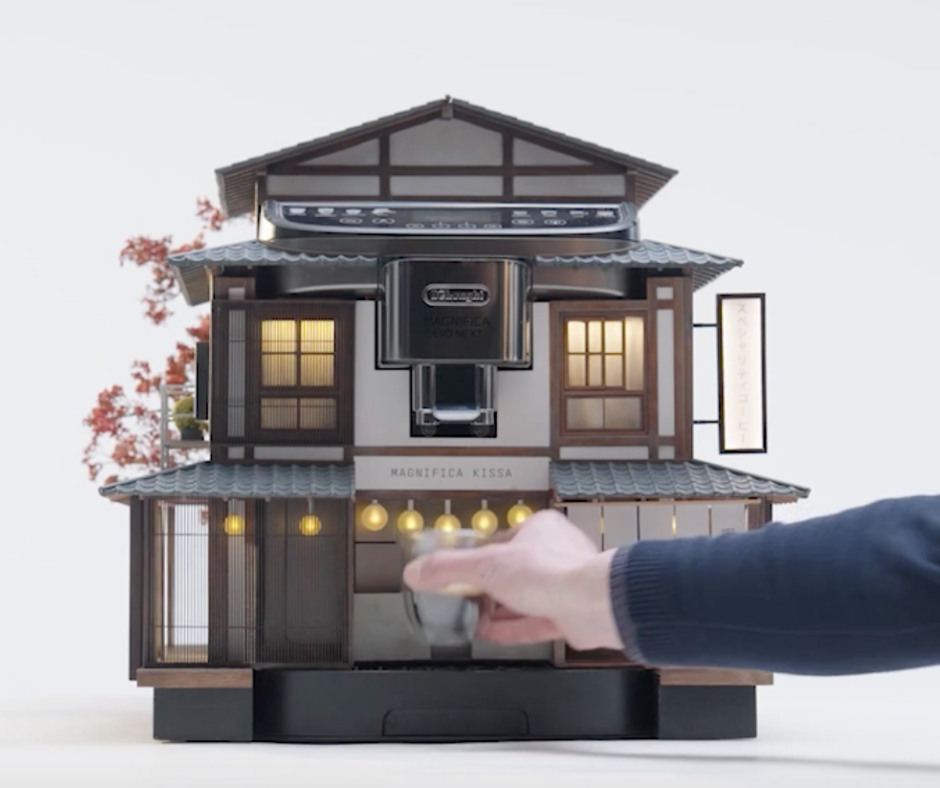
One of the De’Longhi small coffee shops
It’s a genuinely beautiful piece of work. I love it. But it’s also doing a very specific strategic job: De’Longhi is challenging the long-held belief that premium coffee comes from a café, and by miniaturising famous café settings and attaching them to its machines, the brand is shifting the focus from location and experience to the capability of the machine itself. The tiny coffee shop is the machine. And that’s clever.
There’s also Paris Baguette, the café chain with a growing London presence, which has worked with branded merchandise company Brandstamp to create miniature tote bags designed to hold their mini pastries, to celebrate the launch of their new spring drinks and pinsas. It’s cute, and a lovely piece of product thinking for a social media activation — a tiny bag for a tiny thing, the packaging becoming part of the pleasure.
And then there’s the It’s Nice That insights report that arrived recently, called The Tiny Tourist Report. It introduces a new way of thinking about travel and travel storytelling, and it makes the argument that travel marketing has pulled away from the bigger, obvious travel desires, missing the simplest but most compelling moments from the story altogether. The Tiny Tourist isn’t about grand landmarks and bucket-list experiences. It’s about going to the supermarket in a foreign city, noticing the light on a side street, taking your time with something small. It’s about depth over spectacle, and specificity over scale.
So what’s actually going on here?
I think this is a reaction — a continuing one — to the scale and speed of everything else right now. We’re living in an era of AI-generated content, algorithmic feeds, and images that can be conjured in seconds with a text prompt. Everything is bigger, faster, more abundant, more frictionless. And in that context, something that is small and slow and made by hand does something very specific to your attention: it stops it.
If you think about what a miniature actually requires of you as a viewer, you have to look closely. You have to lean in. You can’t scroll past a tiny, hand-built Parisian café façade mounted on a coffee machine in the same way you scroll past a lifestyle flat lay. Your eye wants to stay on it, to find all the details, to appreciate the specificity of it. There’s a kind of forced intimacy that happens with miniature things — they demand your presence and attention in a way that big, bold visual communication often doesn’t.
That’s why this trend makes such good sense as a marketing tool at the moment. Stopping the scroll has become almost impossible using scale. But smallness stops you in your tracks.
I think there’s something else running alongside this too. The handmade quality that tends to accompany miniature work — the hundreds of hours of craftsmanship, the aged finishes and forced perspective techniques, the attention to detail required — carries a kind of cultural weight that feels increasingly precious. Unlike film miniatures designed for a single camera angle, De’Longhi’s tiny coffee shops had to hold up to scrutiny from every direction, which meant the work was “almost doubled.” That’s a level of care you can really see. And in a world where so much is generated rather than made by hand, that legibility matters.
The Tiny Tourist report gestures at this from a travel perspective too — the idea that going deeper into small, specific, ordinary experiences like the local market, the neighbourhood bakery, the corner shop that’s off the map, is more satisfying, more premium even, than ticking off the major attractions. Travellers who think this way aren’t settling for less; they’re choosing more intentional looking.
I think that’s the thread connecting all of these. Miniaturisation, whether in campaign design or travel philosophy or product thinking, is essentially an invitation to pay closer attention, and right now, that’s becoming quite a radical offer.
I write more pieces like this in The Sunday Post, my monthly newsletter on brands, communications and culture. You can sign up to be on the list here.